
Furnace Cleaning vs. Duct Cleaning: What’s the Difference?
Homeowners often confuse furnace cleaning with duct cleaning, leading to frustration when air quality issues persist. Each service addresses different components of the HVAC system, and understanding their distinctions is key to effective maintenance.
- Furnace cleaning targets the internal parts of the heating unit, while duct cleaning focuses on the air distribution pathways. Cleaning one does not affect the other.
- Furnace cleaning improves heating efficiency and safety, whereas duct cleaning enhances air quality by removing dust and allergens.
- Regular maintenance schedules are important: furnace cleaning should occur in early fall, and duct cleaning is recommended every 3–5 years or after major renovations.
What is the difference between furnace cleaning and duct cleaning?
Furnace cleaning focuses on the furnace unit itself, removing dust and debris from its components, while duct cleaning involves cleaning the entire ductwork system that distributes air throughout the home. Homeowners often confuse the two, believing that furnace cleaning also includes duct cleaning, which it does not.
Every winter, a Denver homeowner calls us frustrated because their air still smells dusty after paying for a cleaning last month. When we ask what was done, the answer reveals the confusion: they paid for furnace cleaning and assumed it covered their entire duct system. It did not.
The difference between furnace cleaning vs duct cleaning trips up more Front Range homeowners than almost any other HVAC question. One service handles the heart of your heating equipment. The other handles the pathways that carry air to every room.
Below, you learn exactly which components each service touches, using real scenarios we see in Denver homes. By the end, you can answer the question yourself: do I need both furnace and duct cleaning?
Furnace Cleaning vs Duct Cleaning: The Short Answer
Furnace cleaning is the cleaning of the internal components of your heating unit. Duct cleaning is the removal of dust and debris from the network of ducts that distribute air throughout your home.
They are two separate jobs on two separate parts of your HVAC system. Paying for one does not clean the other.
A quick way to picture it: the furnace is the engine, and the ducts are the roads. Cleaning the engine does nothing for the roads, and paving the roads does nothing for the engine.
What Furnace Cleaning Actually Touches
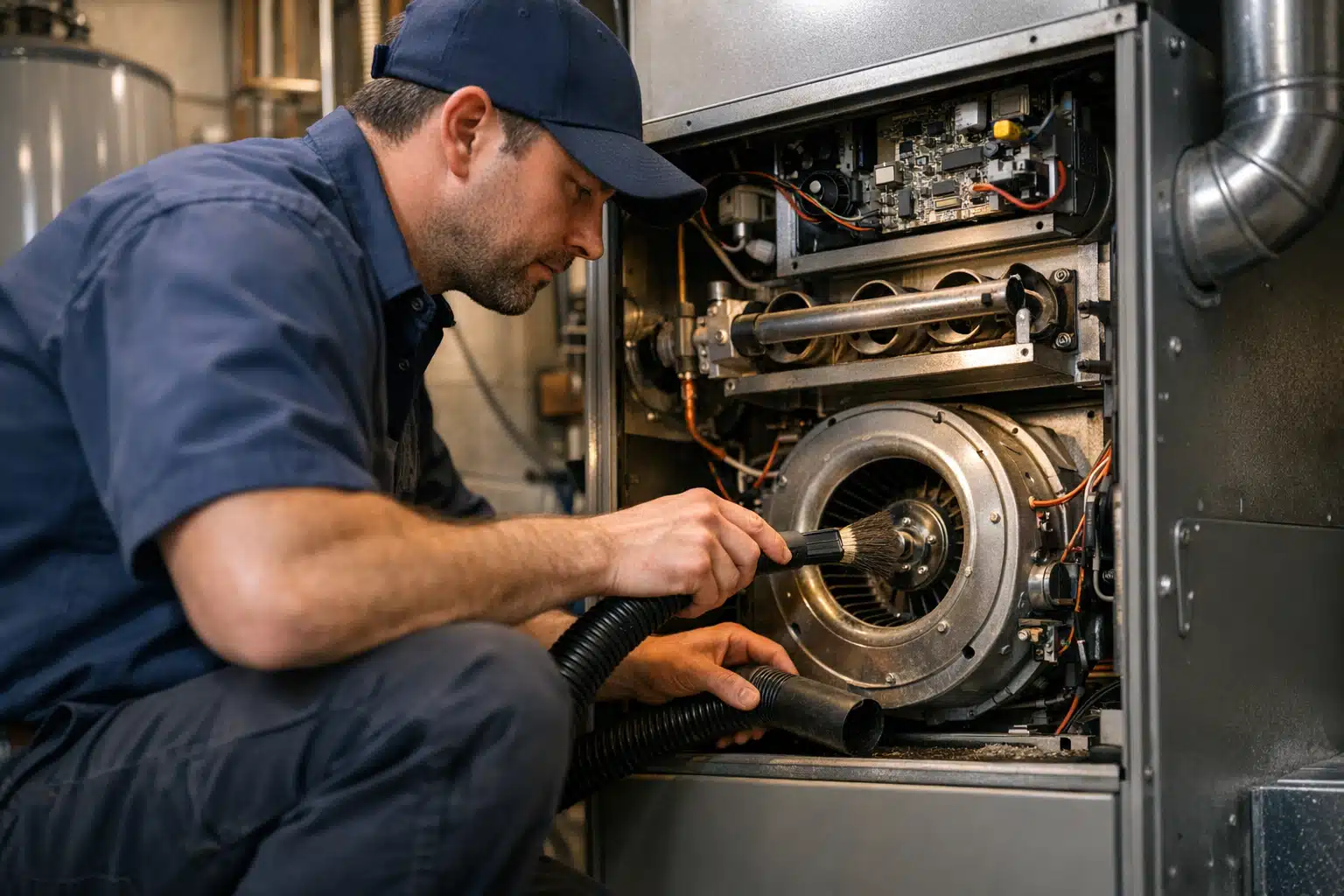
Furnace cleaning focuses on the components inside your heating unit that collect soot, dust, and grime over a heating season. In Denver, where furnaces run hard from October through April, buildup happens fast.
Components a furnace cleaning covers
- Blower motor and blower wheel — the fan that pushes air into your ducts
- Burners — where fuel ignites to produce heat
- Heat exchanger surfaces — where combustion heat transfers to your air
- Flame sensor and igniter — cleaned to prevent short-cycling
- Pilot or ignition assembly
- Internal cabinet and area around the filter slot
A dirty blower wheel is a common culprit behind weak airflow. When caked with dust, the fan blades cannot grab and move air efficiently.
That forces your furnace to work longer to reach the temperature on your thermostat. Higher runtime means higher Xcel Energy bills during a cold Denver stretch.
A field example: the smell that would not leave
One homeowner in Littleton paid for a furnace cleaning after noticing a musty odor when the heat kicked on. The technician cleaned the burners and blower, and the furnace ran fine.
The smell returned within a week. The problem was never the furnace. Years of dust and pet dander had settled inside the supply ducts, and warm air pushed that odor into every room. A furnace cleaning cannot reach that debris.
What Duct Cleaning Actually Touches
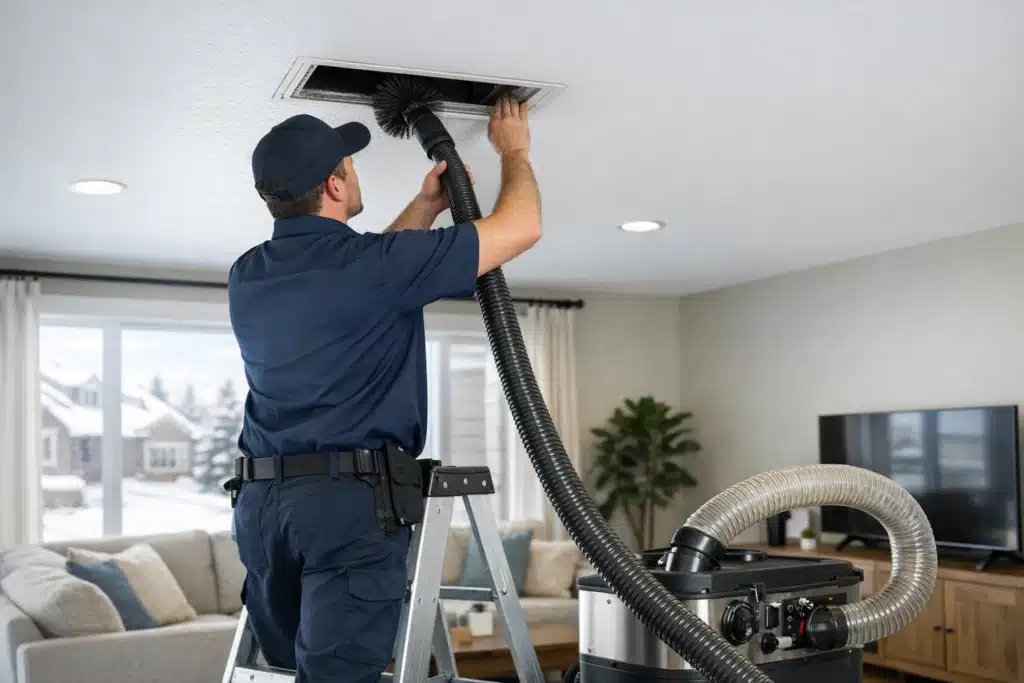
Duct cleaning removes accumulated dust, dander, and debris from the supply and return ducts that move air between your furnace and your living spaces. It reaches areas your furnace cleaning never touches.
Components a duct cleaning covers
- Supply ducts — the branches carrying warm or cool air to each room
- Return ducts — the pathways pulling air back to the system
- Main trunk lines — the large ducts feeding the branches
- Registers and grilles — the vents you see in each room
- Plenum — the boxed area where ducts connect to the furnace
We use negative-air equipment and rotating brushes to dislodge and capture debris. This pulls out the buildup that airflow alone leaves behind for years.
Why Denver homes collect duct debris fast
Denver’s dry, dusty climate feeds duct buildup. Fine dirt from the Front Range, construction dust from nearby development, and pet dander settle inside ductwork over time.
Wildfire smoke seasons add another layer. When smoke infiltrates a home, fine particles settle in return ducts and recirculate every time the system runs. Duct cleaning removes what an air filter cannot catch after it has already passed by.
Furnace Cleaning vs Duct Cleaning: Side-by-Side
| Aspect | Furnace Cleaning | Duct Cleaning |
|---|---|---|
| What it cleans | Internal heating unit parts | Ductwork and vents |
| Main goal | Safe, efficient heating | Cleaner air distribution |
| Helps with airflow | Yes, at the blower | Yes, along the pathways |
| Removes duct dust | No | Yes |
| Improves combustion safety | Yes | No |
| Best timing | Fall, before heating season | Every 3–5 years or as needed |
Do I Need Both Furnace and Duct Cleaning?
For most Denver homes, the answer is yes, but not always at the same time. Each service solves a different problem, and your symptoms point to which one you need.
Signs you need furnace cleaning
- Furnace runs longer than usual to heat the home
- Short-cycling — turning on and off in quick bursts
- A burning-dust smell that fades after a few days each fall
- Yellow or flickering burner flame instead of steady blue
- Rising heating bills without a weather change
Signs you need duct cleaning
- Persistent dusty smell that a furnace cleaning did not fix
- Visible dust blowing from vents when the system starts
- Uneven allergy symptoms room to room
- Recent home renovation or drywall work
- Post-wildfire-smoke residue on registers
The renovation scenario we see often
A property manager in Aurora had a furnace tune-up done before renting a unit. Tenants complained about dust within days of moving in.
The cause was a bathroom remodel completed months earlier. Drywall dust had settled deep in the supply ducts, and no furnace cleaning could remove it. A duct cleaning cleared the problem in a single visit.

Why the Mix-Up Costs Homeowners Money
The confusion between these two jobs leads people to pay for the wrong fix. They spend money, see no improvement, and lose trust in the whole idea of HVAC cleaning.
Understanding which parts each service touches lets you spend on the actual problem. A steady blue flame and clean burners come from furnace cleaning. Clean air arriving at your vents comes from duct cleaning.
When both are neglected, the effects stack. A dirty blower pushes weak airflow, and dirty ducts add contaminants to that already-strained air. Your system works harder, and your indoor air suffers.
Timing and Maintenance for Denver Homes
Schedule these around Colorado’s heating and cooling demands so your system is ready when temperatures swing.
- Furnace cleaning and tune-up: early fall, before the first hard freeze along the Front Range
- Air filter replacement: every 1–3 months during heavy furnace or AC use
- Duct cleaning: every 3–5 years, or sooner after renovation, smoke exposure, or a pet-heavy household
- AC maintenance: spring, before Denver’s warm summer stretch
Neglecting furnace cleaning risks safety issues and higher bills. Neglecting duct cleaning lets allergens and dust recirculate for years. Together, on their own schedules, they keep your air cleaner and your equipment lasting longer.
Key Takeaways
Furnace cleaning handles the internal heating unit, and duct cleaning handles the ductwork that carries your air. Paying for one does not clean the other, which is where most homeowners lose money.
Match the service to your symptoms, and schedule furnace work in fall and duct cleaning every few years or after major events like renovations or wildfire smoke.
Not certain which one your Denver home needs? Action Air Duct can inspect both and point you to the fix that actually solves your problem. Call or text 720‑257‑3319, email tamir@actionairduct.net, or visit https://actionairduct.net to schedule an inspection.