Last month, a Englewood restaurant owner discovered that their HVAC system was circulating cooking grease and food particles throughout their dining area, creating an unpleasant atmosphere that was driving customers away. This scenario highlights why commercial duct cleaning isn't just about maintenance – it's about protecting your business reputation and ensuring a healthy environment for employees and customers.
Commercial duct cleaning involves the thorough removal of dust, debris, contaminants, and biological growth from your business's entire HVAC system. This comprehensive process includes cleaning supply and return air ducts, registers, grilles, diffusers, heat exchangers, cooling coils, condensate drain pans, fan motor and housing, and the air handling unit housing.
Professional commercial duct cleaning becomes particularly important in Englewood due to the area's semi-arid climate and seasonal temperature variations. The dry conditions can increase dust accumulation, while the altitude of 5,431 feet affects air circulation patterns in commercial buildings.
Improved indoor air quality for employees and customers
Enhanced HVAC system efficiency and reduced energy costs
Extended equipment lifespan and reduced maintenance needs
Compliance with health department regulations for food service businesses
Common issues in Englewood, CO
Action Air Duct provides Commercial Duct Cleaning services in all neighborhoods of Englewood including Arapahoe Acres.
Englewood's location in the South Platte River Valley creates unique challenges for commercial HVAC systems. The area's proximity to major transportation corridors like US 285 and Santa Fe Drive means businesses often deal with increased particulate matter from vehicle emissions. Additionally, the city's mix of established neighborhoods and ongoing development projects contributes to higher dust levels that can quickly accumulate in ductwork.
The semi-arid climate with low humidity levels – typically ranging from 15% to 45% – causes dust and debris to become airborne more easily. During spring months, pollen from cottonwood trees and native grasses creates additional challenges for businesses, particularly those in the hospitality and healthcare sectors.
Seasonal temperature swings in Englewood can be dramatic, with summer highs reaching the 90s and winter lows dropping below freezing. These fluctuations cause HVAC systems to work harder, potentially drawing more contaminants through the ductwork and creating condensation issues that can lead to mold growth.
Dust accumulation from construction and road traffic along major corridors
Pollen infiltration during spring and early summer months
Low humidity levels causing increased static and dust circulation
Temperature extremes leading to condensation and potential mold issues
Restaurant grease and cooking particles in food service establishments
Pet dander and allergens in retail spaces that allow animals
Our commercial duct cleaning process begins with a comprehensive inspection using advanced camera equipment to document the current condition of your ductwork. We identify problem areas, assess contamination levels, and develop a customized cleaning plan specific to your business type and building layout.
Our systematic approach addresses every component of your HVAC system:
Complete system shutdown and safety preparation
Access point creation with minimal disruption to your operations
Negative pressure establishment using powerful HEPA-filtered vacuum systems
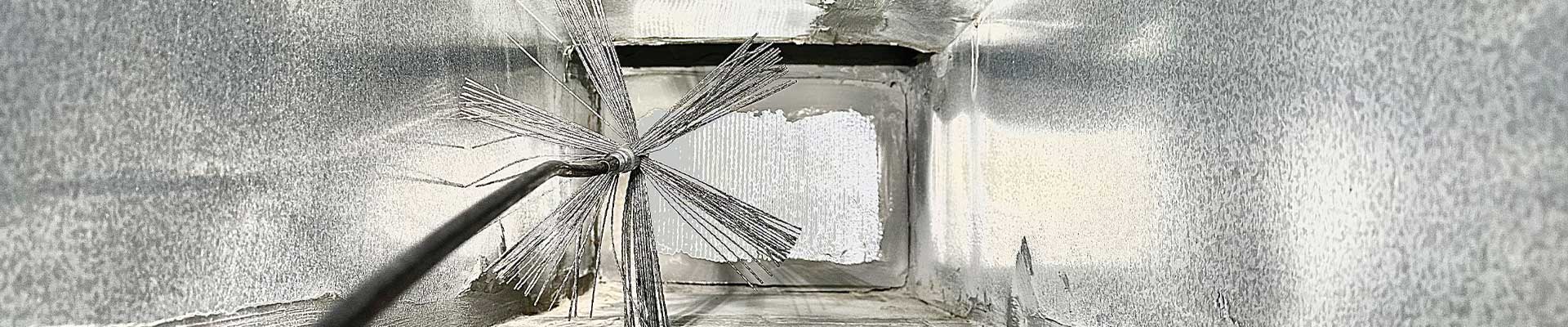
Agitation cleaning of all ductwork using rotating brushes and compressed air
Component-by-component cleaning of registers, grilles, and diffusers
Coil cleaning and condensate pan treatment
Final inspection and documentation with before-and-after photos
We use specialized equipment designed for commercial applications, including truck-mounted vacuum systems that provide consistent negative pressure throughout the cleaning process. Our team coordinates with your facility management to minimize business disruption, often working during off-hours or scheduled maintenance windows.
HEPA filtration systems to contain all removed contaminants
Antimicrobial treatments for businesses requiring enhanced sanitation
Detailed reporting with photographic documentation
Ongoing maintenance scheduling to prevent future accumulation
Action Air Duct brings certified expertise to every commercial project in Englewood. Our technicians hold NADCA (National Air Duct Cleaners Association) certifications and receive ongoing training on the latest commercial cleaning techniques and safety protocols. We maintain full licensing and insurance coverage specifically for commercial work, including general liability and workers' compensation.
Our local presence in the Denver metro area means we understand Englewood's specific environmental challenges and building types. We've worked extensively with the mixed-use developments along South Broadway and the established commercial districts near Englewood City Center, giving us insight into the unique HVAC configurations common in the area.
We guarantee our work with detailed documentation and follow-up inspections. Our response time for commercial emergencies is typically within 24 hours, and we maintain flexible scheduling to accommodate your business operations. Our equipment fleet includes the latest truck-mounted systems and portable units designed specifically for commercial applications.
NADCA-certified technicians with commercial specialization
Local knowledge of Englewood's building types and environmental factors
24-hour emergency response capability
Comprehensive documentation and quality assurance protocols
Englewood's commercial building stock reflects the city's development history, with many structures built during the 1960s through 1980s economic growth period. The downtown area features a mix of mid-century commercial buildings and newer mixed-use developments, while the South Broadway corridor contains strip malls and standalone retail buildings from various eras. Many of these older commercial buildings were constructed before modern HVAC efficiency standards, resulting in ductwork systems that may have accessibility challenges or outdated materials.
The city's proximity to downtown Denver has driven recent redevelopment, particularly around the Englewood City Center and along major transit corridors. These newer commercial spaces often feature more complex HVAC systems with multiple zones and advanced filtration, requiring specialized cleaning approaches. However, many established businesses operate in buildings with original ductwork that hasn't been professionally cleaned in decades.
Commercial buildings in Englewood frequently feature concrete slab construction with ductwork running through ceiling spaces or underground. This construction method can create unique access challenges and may require specialized equipment to reach all system components effectively.
Mid-century buildings with potentially outdated ductwork materials
Mixed-use developments requiring coordination with multiple tenants
Underground ductwork in slab construction requiring specialized access
Varying ceiling heights and accessibility in older retail spaces
Englewood sits at an elevation of 5,431 feet in Colorado's Front Range, creating unique environmental conditions that directly impact commercial HVAC systems. The city experiences a semi-arid climate with low annual precipitation of approximately 15 inches and relative humidity levels that frequently drop below 30%. These dry conditions cause dust and particulate matter to remain airborne longer, leading to faster accumulation in ductwork systems compared to more humid climates.
Air quality in Englewood is influenced by its position in the Denver-Aurora-Lakewood metropolitan area, which occasionally experiences ozone and particulate matter concerns, particularly during summer months and winter inversion events. The Colorado Department of Public Health and Environment monitors air quality, and businesses in the area must consider how external air pollution affects their indoor environments. Additionally, Englewood's location near major highways including US 285, C-470, and Santa Fe Drive means commercial buildings are exposed to vehicle emissions and road dust.
The area's soil composition consists primarily of clay and sandy loam, which can become airborne during construction activities and high wind events common in the spring months. Englewood also experiences significant temperature variations, with summer highs reaching into the 90s and winter lows dropping well below freezing, creating thermal stress on HVAC systems that can affect ductwork integrity and condensation patterns.
Low humidity levels accelerating dust accumulation and static buildup
Seasonal ozone and particulate matter concerns affecting indoor air quality
High-altitude conditions requiring HVAC systems to work harder
Temperature extremes causing thermal expansion and potential ductwork gaps
Air Quality and HVAC Performance in Englewood
Englewood's air quality is monitored by the Colorado Department of Public Health and Environment, which reports that the city experiences moderate air quality conditions throughout most of the year, with occasional periods of concern during summer ozone season and winter temperature inversions. The area's Air Quality Index (AQI) typically ranges from 25-75 on most days, but can spike to unhealthy levels during wildfire events or high pollution days, directly impacting commercial HVAC system performance and contamination rates.
The city's location in the South Platte River Valley creates unique atmospheric conditions that affect commercial buildings. During winter months, temperature inversions can trap pollutants near ground level, increasing the burden on HVAC filtration systems. Commercial buildings in Englewood report higher filter replacement frequencies compared to similar facilities at lower elevations, indicating increased particulate loading in ductwork systems.
Recent studies by the Colorado Air Quality Control Commission show that Front Range communities like Englewood experience elevated levels of PM2.5 and PM10 particulate matter, particularly during construction season and drought conditions. These fine particles can penetrate standard commercial HVAC filters and accumulate in ductwork, requiring more frequent professional cleaning to maintain indoor air quality standards.
Average AQI ranging from 25-75 with seasonal spikes during inversions
Elevated PM2.5 levels during construction and drought periods
Winter temperature inversions increasing pollutant concentration
Higher HVAC filter replacement frequency due to altitude and climate
Wildfire smoke events creating temporary but significant air quality challenges