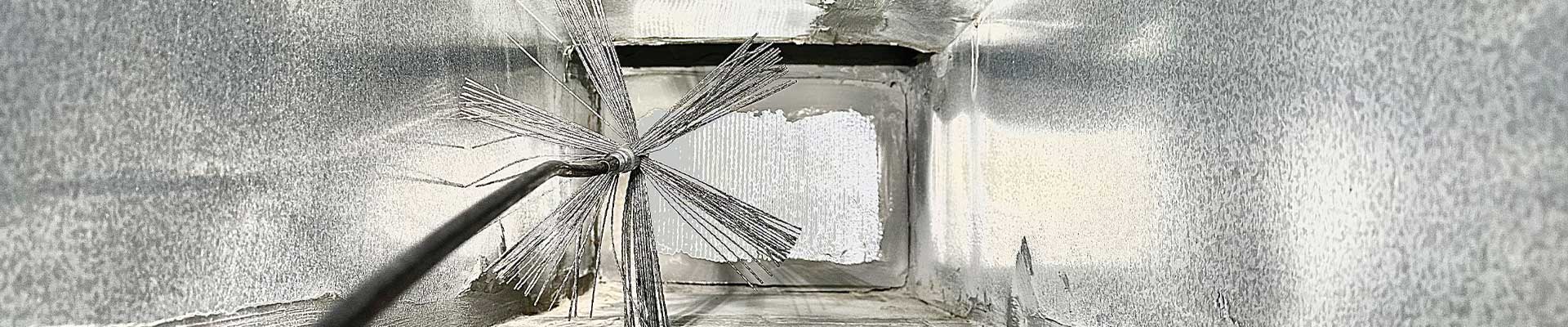
Your commercial building's air quality directly impacts employee productivity, customer comfort, and operational costs. When dust, debris, and contaminants accumulate in your HVAC system, they create a cascade of problems that affect everyone who enters your space.
Commercial duct cleaning involves the thorough removal of accumulated dust, debris, allergens, and contaminants from your building's entire HVAC system. This process includes cleaning supply and return air ducts, registers, grilles, diffusers, heat exchangers, cooling coils, condensate drain pans, fan motor and housing, and the air handling unit housing.
Improved indoor air quality for employees and customers
Enhanced HVAC system efficiency and reduced energy costs
Extended equipment lifespan through reduced strain on components
Elimination of musty odors and airborne contaminants
Louisville's unique Front Range location brings specific challenges – from seasonal pollen surges to construction dust from the area's ongoing development. Professional commercial duct cleaning addresses these local factors while ensuring your business maintains the healthy indoor environment your team deserves.
Common issues in Louisville, CO
Action Air Duct provides Commercial Duct Cleaning services in all neighborhoods of Louisville including Balfour, Centennial Heights, Cherrywood II, Eagle Place, Paragon Estates, Parco Dello Zingaro, Steel Ranch Subdivision, and Waneka Landing.
Louisville's position along the Front Range creates a perfect storm of airborne contaminants that infiltrate commercial HVAC systems. The area's rapid growth means construction dust is practically constant, while seasonal wind patterns carry allergens and particulates from across the Colorado plains.
Spring brings intense pollen loads from cottonwoods and other Front Range vegetation, while summer dust storms can deposit significant amounts of fine particles into building systems. Winter's dry conditions create static buildup that attracts and holds contaminants in ductwork longer than in more humid climates.
The combination of Louisville's elevation and Colorado's intense UV exposure also accelerates the breakdown of duct materials and sealants, creating additional debris sources within the system itself.
Construction dust from ongoing commercial and residential development
Seasonal pollen surges from cottonwoods, grasses, and ragweed
Fine particulate matter from prairie dust storms and wind events
Accelerated duct material degradation due to high-altitude UV exposure
Static buildup from low humidity that attracts and holds contaminants
Wildfire smoke infiltration during Colorado's fire season
Our comprehensive commercial duct cleaning process begins with a detailed inspection using advanced camera equipment to assess contamination levels and identify problem areas throughout your system.
Complete system assessment and documentation of current conditions
Strategic access point creation to reach all ductwork sections
Negative pressure containment setup to prevent cross-contamination
Mechanical agitation and high-powered vacuum extraction of debris
Sanitization treatment of all cleaned surfaces and components
Final inspection and air quality verification testing
We use specialized equipment designed for commercial-scale systems, including truck-mounted vacuum units that provide consistent suction power throughout the cleaning process. Our technicians are trained in proper containment procedures to ensure your business operations continue with minimal disruption.
HEPA-filtered vacuum systems that capture particles down to 0.3 microns
Rotary brush systems for thorough mechanical cleaning
EPA-approved antimicrobial treatments for long-lasting protection
Real-time air quality monitoring during and after service
Every project concludes with detailed documentation showing before and after conditions, plus recommendations for maintaining optimal air quality between professional cleanings.
Our NADCA (National Air Duct Cleaners Association) certification demonstrates our commitment to industry best practices, while our local Louisville presence means we understand the specific challenges your building faces from Front Range environmental conditions.
We maintain rapid response capabilities for urgent air quality issues and provide flexible scheduling that works around your business operations. Our technicians carry comprehensive insurance coverage and follow strict safety protocols for commercial environments.
NADCA-certified technicians with ongoing professional development
Local Louisville knowledge of seasonal and environmental factors
Same-day emergency response for critical air quality situations
Comprehensive liability insurance and worker compensation coverage
Detailed documentation and maintenance recommendations included
We stand behind our work with follow-up air quality testing and provide ongoing maintenance guidance to help you maximize the investment in your building's air quality.
Louisville's commercial building stock reflects the city's transformation from a historic coal mining town to a modern Front Range business hub. Many older commercial buildings date from the 1960s through 1980s, featuring metal ductwork systems that were built for durability but lack modern filtration capabilities.
The area's newer commercial developments, particularly those built after 2000, incorporate more complex HVAC systems with variable air volume controls and energy recovery ventilators. These advanced systems require specialized cleaning techniques and equipment to properly maintain all components without disrupting sophisticated control mechanisms.
Older buildings often have oversized ductwork that accumulates debris in low-velocity zones
Historic buildings may contain asbestos-wrapped ducts requiring specialized handling
Modern energy-efficient buildings have tighter construction that amplifies indoor air quality issues
Mixed-use developments combine residential and commercial systems with varying maintenance needs
Louisville's elevation at 5,348 feet also affects HVAC system performance, as the thinner air requires different airflow calculations and can accelerate dust accumulation in certain duct configurations. Buildings constructed before Colorado's updated energy codes may have inadequate filtration for the area's challenging environmental conditions.
Louisville sits in a unique microclimate where the Great Plains meet the Rocky Mountain foothills, creating complex air quality challenges for commercial buildings. The area experiences frequent chinook winds that can rapidly change atmospheric pressure and drive contaminants deep into HVAC systems.
Air quality monitoring data shows Louisville experiences elevated particulate matter levels during spring and fall, with PM2.5 concentrations often exceeding EPA recommendations during wildfire events. The city's proximity to both urban Denver pollution and agricultural dust sources creates a complex mix of contaminants that standard commercial filters struggle to capture.
Seasonal PM2.5 spikes during wildfire season require more frequent duct cleaning
High-altitude UV exposure accelerates breakdown of duct sealants and materials
Rapid temperature fluctuations cause expansion and contraction that loosens debris
Prairie grass pollen and agricultural dust create unique filtration challenges
The combination of Louisville's 300+ days of sunshine annually and frequent temperature swings creates ideal conditions for mold and bacteria growth in HVAC systems, particularly in areas where condensation can occur. Regular professional cleaning becomes even more critical in this environment to prevent biological contamination that can impact employee health and productivity.
Air Quality Data in Louisville
Louisville's air quality monitoring reveals significant seasonal variations that directly impact commercial HVAC system contamination rates. Colorado Department of Public Health data shows the area experiences unhealthy air quality days primarily during wildfire season (July through September) and during spring dust events when winds exceed 25 mph.
The city's location in the Denver-Boulder metropolitan area means it receives both urban pollutants and natural particulates. Ground-level ozone concentrations frequently exceed federal standards during summer months, while winter inversions can trap pollutants close to ground level where commercial building air intakes operate.
Average of 45-60 days annually with elevated particulate matter levels
Spring pollen counts often exceed 1,000 grains per cubic meter
Wildfire smoke events can increase PM2.5 levels by 300-500% overnight
Construction dust from ongoing development adds localized contamination
Winter temperature inversions concentrate pollutants at building intake levels
These environmental conditions mean Louisville commercial buildings require more frequent duct cleaning than the national average. The combination of natural and human-made contaminants creates a challenging environment where standard maintenance schedules often prove inadequate for maintaining healthy indoor air quality. Professional assessment of your specific building's contamination rate helps determine the optimal cleaning frequency for your location and usage patterns.