
How Often Should Commercial Ducts Be Cleaned? A Facility Guide
Commercial duct cleaning frequency varies based on building type and activity levels. Facilities should not follow a one-size-fits-all schedule, as factors like occupancy and air quality demands play a significant role.
- Medical facilities require cleaning every 1 to 2 years due to high contamination sensitivity. Offices typically need cleaning every 3 to 5 years, depending on occupancy and activity levels. Gyms should be cleaned every 1 to 2 years because of moisture and organic particles, while warehouses may require cleaning every 2 to 4 years based on floor activity.
- A medical clinic and a Denver warehouse should never follow [...] A medical clinic and a Denver warehouse should never follow the same duct cleaning schedule.
- Yet most facility managers hear one vague answer to the question of how often clean commercial ducts: “every few years.” That number ignores what actually drives buildup — occupancy, activity, and what floats around inside your building.
How often should commercial ducts be cleaned?
The cleaning frequency for commercial ducts varies based on factors such as occupancy, building activity, and the type of contaminants present. Unlike a one-size-fits-all approach, facility managers should assess these elements to determine an appropriate cleaning schedule, ensuring optimal air quality and system efficiency.
A medical clinic and a Denver warehouse should never follow the same duct cleaning schedule. Yet most facility managers hear one vague answer to the question of how often clean commercial ducts: “every few years.” That number ignores what actually drives buildup — occupancy, activity, and what floats around inside your building.
This article breaks commercial duct cleaning frequency down by building type, following the framework used by NADCA (the National Air Duct Cleaners Association). You will learn realistic intervals for medical facilities, offices, gyms, and warehouses along Colorado’s Front Range.
How Often Should You Clean Commercial Ducts? The Direct Answer
Most commercial buildings need duct cleaning every 2 to 5 years. The exact interval depends on occupancy density, indoor activity, and air quality demands. High-traffic or contamination-sensitive buildings fall on the shorter end.
NADCA recommends cleaning when a system shows visible contamination, not on a rigid calendar alone. Two conditions trigger a cleaning:
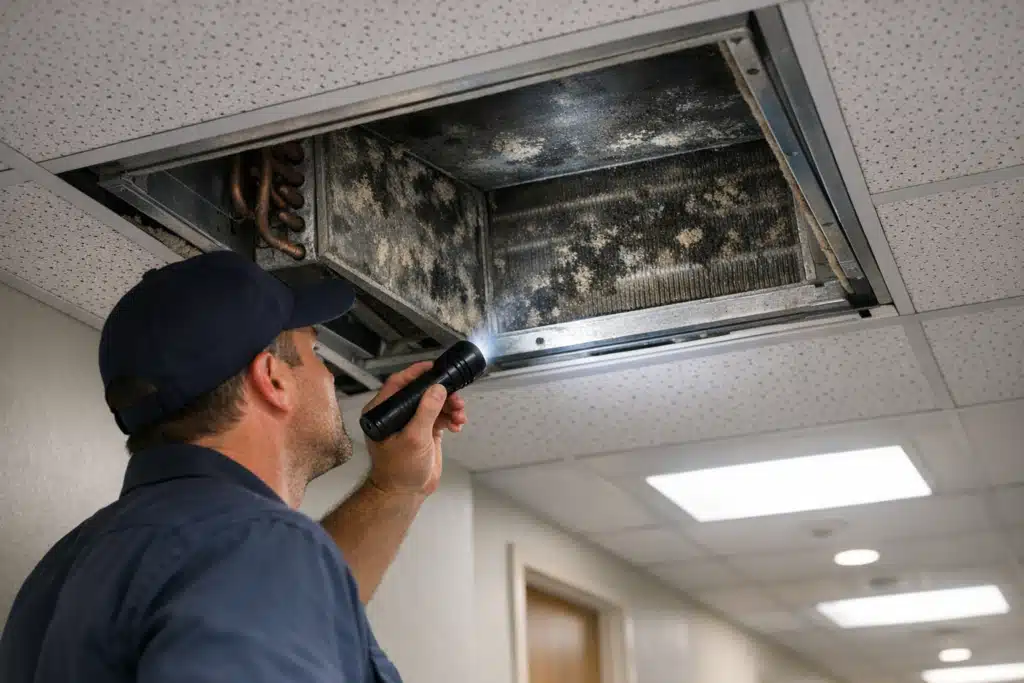
- Visible mold growth on ducts, coils, or other system components
- Debris, dust, or particulate being released into occupied spaces
Denver’s climate adds pressure to both. Dry air stirs fine dust, and summer wildfire smoke pulls smoke particles into return air across the metro area.
Why Building Type Changes the Schedule
Occupancy and activity control how fast your ducts load with contaminants. A quiet office and a rubber-floored gym produce different air burdens per square foot. That difference decides your interval.
Three variables drive nearly every commercial schedule:
- People per square foot — more occupants mean more skin cells, moisture, and airborne particles
- Indoor activity — cooking, manufacturing, and exercise generate grease, dust, and humidity
- Air quality sensitivity — clinics and labs tolerate far less contamination than storage spaces
Below is how each building type maps to a real interval.
Commercial Duct Cleaning Frequency by Building Type
Medical and Healthcare Facilities: Every 1 to 2 Years
Medical buildings carry the shortest interval of any commercial property. Clinics, dental offices, surgical centers, and assisted living need duct cleaning every 1 to 2 years. Some critical areas require attention on an even tighter schedule.
The reason is contamination tolerance. Immunocompromised patients cannot share space with mold spores or biofilm in the airstream. A single dirty coil can spread pathogens across an entire floor.
Denver clinics face an added issue in spring and summer. High pollen counts and wildfire smoke infiltrate return air, loading filters and ducts faster than a sealed office would experience.
Office Buildings: Every 3 to 5 Years
Standard office space needs duct cleaning every 3 to 5 years under normal occupancy. Cubicle floors, private suites, and mixed-use commercial buildings fit this range. Push toward the 3-year mark if your building runs high density or older ventilation.
Offices seem clean, but they accumulate a specific mix:
- Carpet fibers and printer toner circulating through returns
- Dead skin and fine dust from dense occupancy
- Construction dust after tenant improvements or remodels
A Denver office that just finished a buildout should schedule cleaning regardless of its calendar. Drywall dust coats duct interiors and reduces airflow within weeks.
Gyms and Fitness Centers: Every 1 to 2 Years
Gyms need duct cleaning every 1 to 2 years because of moisture and human output. Heavy breathing, sweat, and constant occupancy load the air with humidity and organic particles. That combination feeds mold inside duct runs.
Locker rooms and group fitness studios are the worst offenders. Warm, humid air moves into return ducts and condenses when it hits cooler metal. Damp duct walls collect dust and grow biofilm fast.
Front Range gyms deal with a swing most buildings avoid. Winter heating dries the air, then summer AC fights indoor humidity from packed classes. The system cycles hard, pulling more airborne debris across the year.
Warehouses and Industrial Spaces: Every 2 to 4 Years
Warehouses need duct cleaning every 2 to 4 years, with the interval driven by what happens on the floor. A climate-controlled storage warehouse stays cleaner than a facility with forklifts, sawdust, or packaging lines. Match the schedule to your operation.
Warehouse air holds coarse contaminants other buildings never see:
- Forklift exhaust in facilities running propane or diesel equipment
- Cardboard and pallet dust from constant loading
- Fine particulate from grinding, cutting, or assembly work
Denver warehouses near I-70 and the northeast corridor face outside dust intrusion too. Large bay doors pull in road grit and construction particulate whenever they open.
Building Type Frequency Comparison
Use this side-by-side reference for planning your facility budget:
- Medical / Healthcare: every 1–2 years — lowest contamination tolerance
- Gym / Fitness: every 1–2 years — high moisture and occupancy
- Warehouse / Industrial: every 2–4 years — depends on floor activity
- Office / Commercial: every 3–5 years — standard occupancy
- Restaurant / Kitchen: more frequent — grease demands separate exhaust cleaning
Warning Signs Your Ducts Need Cleaning Now
Calendar intervals set a baseline, but conditions can move your date up. Watch for signals that contamination has already built up. Any of the following warrants an inspection before your scheduled interval:
- Visible dust blowing from supply vents when the system starts
- Musty or stale odors that spread when the fan runs
- Rising complaints about allergies, congestion, or headaches among staff
- Uneven airflow or weak output from certain vents
- Filters clogging faster than their normal replacement window
Filter behavior is your cheapest diagnostic. If a filter that lasted three months now loads in six weeks, something upstream is feeding it.

What Neglected Commercial Ducts Cost You
Skipping duct maintenance shows up in three places: air quality, energy bills, and equipment life. Contaminated ducts recirculate particles staff breathe all day. That drives sick-day complaints and tenant dissatisfaction.
Restricted airflow forces your blower and compressor to work harder. In Denver’s temperature swings, that extra load hits during peak heating and cooling months. Higher runtime means higher utility costs and faster wear.
Neglect also shortens equipment lifespan. A coil caked with debris loses heat-transfer efficiency and can fail years early. Cleaning protects the capital investment already sitting on your roof.
What to Expect From a Commercial Duct Cleaning
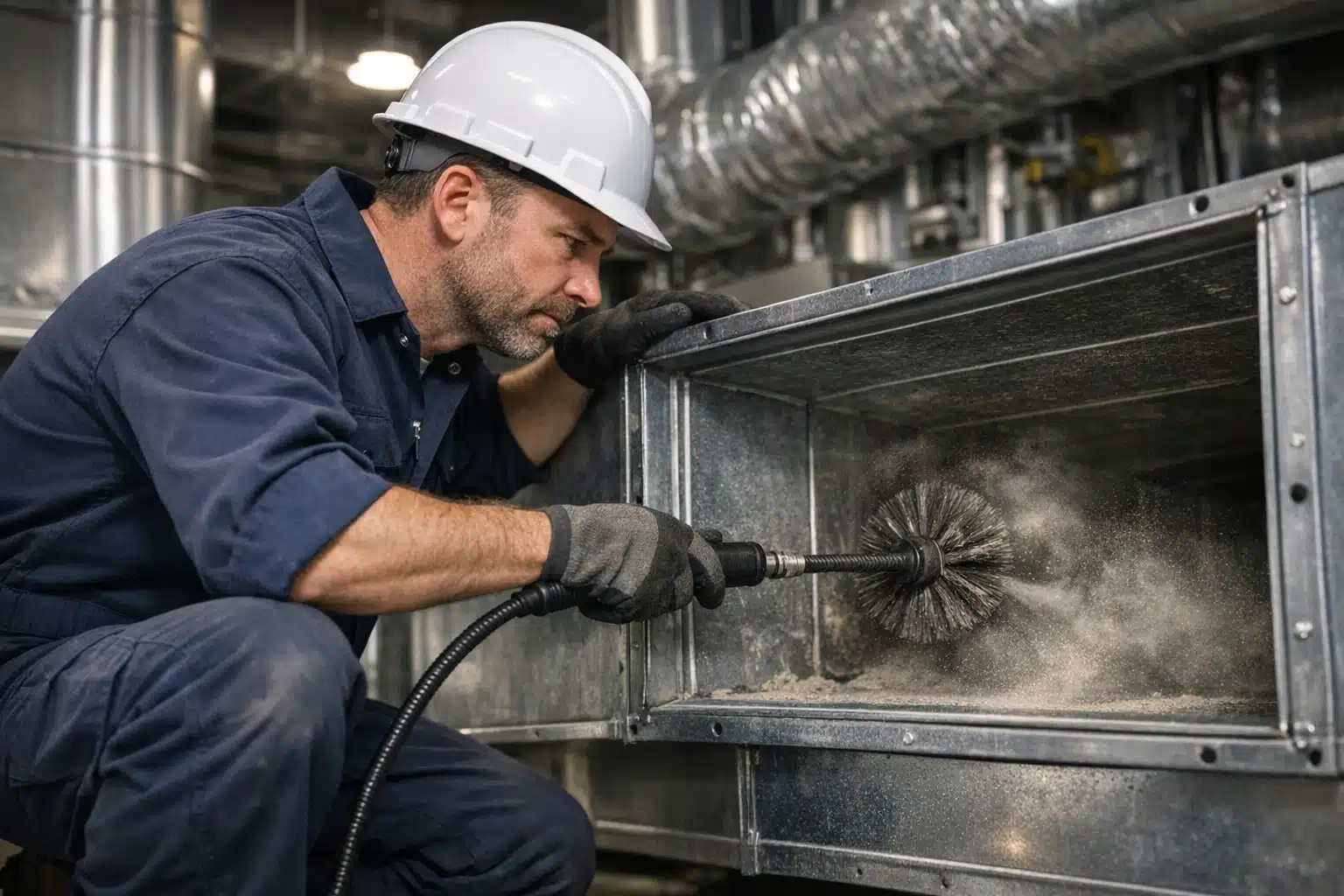
A proper commercial cleaning follows NADCA methods, not a shop-vac and a promise. The work should account for your building’s size and system layout. Expect the crew to address the full airside, not just accessible vents.
A thorough visit covers:
- Inspection of ducts, coils, and air handlers, often with camera verification
- Source removal using negative-air containment and agitation tools
- Coil and drain pan cleaning where mold and biofilm collect
- Post-cleaning verification to confirm debris was removed, not redistributed
Ask any contractor whether they follow NADCA source-removal standards. That single question separates real cleaning from surface-level work.
Building a Maintenance Schedule That Fits Denver
Set your baseline interval by building type, then adjust for local conditions. Front Range facilities should tighten schedules during wildfire season and after major dust events. Pair duct cleaning with filter upgrades to slow future buildup.
Two practical steps for any Denver facility manager:
- Inspect annually even if cleaning is on a multi-year cycle
- Log filter changes to catch contamination trends early
An annual inspection costs little and catches problems before they compound. It also gives you documented proof of maintenance for tenants and health inspectors.
Conclusion
The right cleaning interval depends on what your building does, not a one-size number. Medical facilities and gyms need attention every 1 to 2 years, warehouses every 2 to 4, and offices every 3 to 5. Matching your schedule to your building type protects air quality, controls energy costs, and extends equipment life.
Action Air Duct handles commercial duct cleaning for Denver medical, office, gym, and warehouse facilities using NADCA-based methods. To schedule an inspection or set a maintenance plan for your building, call or text 720‑257‑3319, email tamir@actionairduct.net, or visit https://actionairduct.net.